Showing posts with label junkyard. Show all posts
2.01.2014
Harley Graveyard in Lima, Peru
"MOTO HARLEY DAVIDSON MODEL FJL, THE SALE IN THE STATE AS IS, belonged to the PNP IS THE YEAR 1998 HAS polisa AND OTHER DOCUMENTS, LISTEN TO SERIOUS OFFERS ... "
http://limacallao.olx.com.pe/vendo-moto-harley-davidson-iid-141901045
This guy apparently grabbed a few (or all)... more on a forum HERE (en espanol).
Ah, the days I wish I was independently wealthy...
12.09.2013
The Arthur Kill Ship Graveyard
The Arthur Kill (from the Dutch achter kill , or back channel) is a tidal strait separating Staten Island, New York City from mainland New Jersey. Also known as Staten Island Sound, it's a major navigational channel for the Port of New York and New Jersey. The Jersey side is primarily lined with industrial sites, knows as "the Chemical Coast": the Staten Island side is primarily salt marsh.
The channel runs some 10 miles (16 km), connecting Raritan Bay on its south end with Newark Bay on the north. Arthur Kill Road follows the marshes towards the southern tip of Staten Island, once a major traffic artery but now mostly replaced by the West Shore expressway.
Near the southern end at Rossville -a town once known as "Blazing Star"- there's a wide bend in the channel. Since the 1930's a shallow tidal flat there has hosted one of the last remaining commercial marine-salvage yards in the city, becoming a final port for almost a century of abandoned and wrecked ships. Known as Witte’s Marine Equipment Company since 1947 and still operating as Donjon Marine, the company has salvaged materials from hundreds of wrecked and disused vessels scattered throughout the New York and New Jersey waterways.
![]() |
| Miru Kim (Naked City Spleen) |
Since the company's founder, John J. Witte, died in 1980 his successors have been dismantling the ships. Mr. Witte allowed the ships to accumulate and refused to strip or cut up anything unless he had buyers for the materials, but like many waterfront artifacts the old ships in the yard are disappearing. There were once up to 400 vessels, some dating from before World War I: only a handful remain. All the ships are scuttled but the shallow water means that most are well visible above the water.
![]() |
| Abram S. Hewitt passing the Brooklyn Bridge |
One of the most famous ships rusting into the mud flts is the Abram S. Hewitt (1903-1958), the last coal burning fireboat of the NYC fire department.
On June 15, 1904, the Hewitt was involved in fighting a fire aboard the PS General Slocum, a large paddle-steamer carrying 1,400 passengers to a picnic at Eatson Neck, Long Island. The ship caught on fire an hour into its trip and an estimated 1,021 lives were lost, mostly women and children. The event later came to be known as the “General Slocum tragedy”, and was the worst loss of life in New York City until September 11, 2001.

Another relic is the US Navy Submarine Hunter PC-1264, one of only two U.S. Navy ships to have a predominately African-American enlisted complement during the war. PC-1264 served as an Eastern Seaboard escort, operating from its base in New York to Key West and Guantanamo Bay. In early January 1945 the ship's mission was changed from convoy escort to anti-submarine duty, and began patrolling areas from Long Island south to Cape Charles. She was decommissioned in February 1946, serving a little less than 22 months as a U.S. Navy fighting ship, but the crew's performance helped convince the Navy to reevaluate its perception of African Americans as members of the fleet.
USS ATR-89 was built during WWII as a ATR-1 Class Rescue Tug for the US Navy and served in the US Atlantic Fleet for 3 years before she was decommissioned and sold into commercial service. Purchased by the Mutual Ocean Transportation Co of Jacksonville, FL in 1947, the former ATR-89 was renamed Hila and operated in the commercial trades for the remainder of her service life. The Hila broke down in the late 50′s on a voyage from Miami, and was eventually sold for scrapping in the late 70's to early 80's.
![]() |
| The Bloxom (aka LT-653) was built in Point Pleasant, WV, for the US Army in 1944. |
![]() |
| Port Johnson NJ, 1930's |
![]() |
| Kill Van Kull 1971 |

John A. Noble, the son of the noted American painter, John ("Wichita Bill") Noble spent his early years in the studios of his father and later worked as a seaman on schooners and in marine salvage. While towing out down the nearby Kill van Kull in 1928 he saw the old Port Johnston coal docks: "the largest graveyard of wooden sailing vessels in the world." Filled with new but obsolete ships, the coalport had become a boneyard, and Noble built a floating studio there from parts of the abandoned ships. From 1946 on, he worked as a full-time artist, making a life’s work of documenting the slow obsolescence of sailing and steam vessels along the Arthur Kill and the Kill van Kull. Noble died in 1983, but his studio survives at the Noble Maritime Collection at Staten Island’s Snug Harbor Cultural Center.
Although Witte’s is the largest remaining marine boneyard on the Kill, multiple other wrecks line the marshland along its muddy banks.The Rossville shipyard is slowly rotting away; Donjon Marine Company seems to be taking a more proactive approach to actually salvaging materials from the wrecks and keeping the curious out, having erecting 12-foot metal walls around the perimeter of the yard with signs prohibiting any and all photography. In all fairness it is a working salvage yard and as such presents certain dangers to onlookers. Still, the area is popular with kayakers and photographers intent on recording the history there.
More Info:
The Witte Boneyard- a different kind of graveyard
A Lesson in the History of Ships; 1990 NY Times
A Watery Grave for Historic Ships on Staten Island
Shaun O'Boyle photography
Graves of Arthur Kill- 3fishproductions
tugster.wordpress.com
The Ships of Arthur Kill -windagainstcurrent.com
List of Shipwrecks in the National Register of Historic Places
9.22.2013
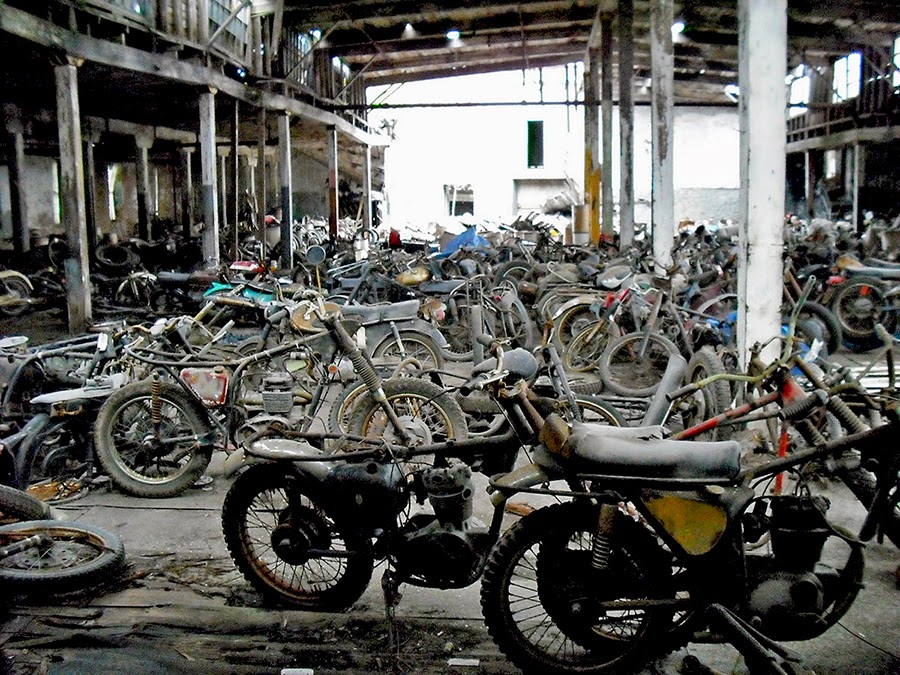
The Lockport Motorcycle Graveyard
I first started finding pics of this place online a few years ago- sporadically at first, but as word spread around the internet more started popping up. It was only recently that I found the full story on the place, thanks to Dynamite Dave. Appears that it was even featured in an issue of Iron Horse back in 2010, but considering that I'm way out on the fringes of Western Kulture I somehow missed that issue.
The first references I saw for this place was a photoset by Chris Seward done as part of a gallery exhibit for the University of Rochester back in 2010.
"Dave" apparently saw the same set, and being both a) about 4500 miles closer to the scene and b) invested with significantly more enthusiasm, he decided to track it down. In September 2010 he rode up to Lockport NY. with a buddy and found the building, doing a bit of the old surreptitious broad daylight URBEX (which always gets the adrenaline flowing) and grabbing a few pics. He later managed to get a pretty good history of the building and the bikes, and tracked down the owner.
The motorcycles were collected by Walter Kohl, who along with his wife Anna owned and operated several bike shops around Lockport NY over a 60 year time period. In 1969 Kohl established "Kohl’s Motorcycle Sales and Service" at 12 West Main Street; he moved the shop in 1974 to Richmond Ave. but kept the West Main building until 1986 for storage. The Kohls were dealers for BSA, Moto Guzzi, and Yamaha at various points, possibly Triumph as well: they would also take trade-ins, and bought inventories of defunct dealerships.
Kohl had several other locations for storage, both in Lockport and Niagara falls. In the early 1970's he purchased the building at 71 Gooding St. which eventually gained fame as the graveyard. Originally constructed in 1875 for a brass bed frame company, the building had easy access to the Erie Canal which must have made it popular, and among other things it historically served as a cider mill and ceramics factory.
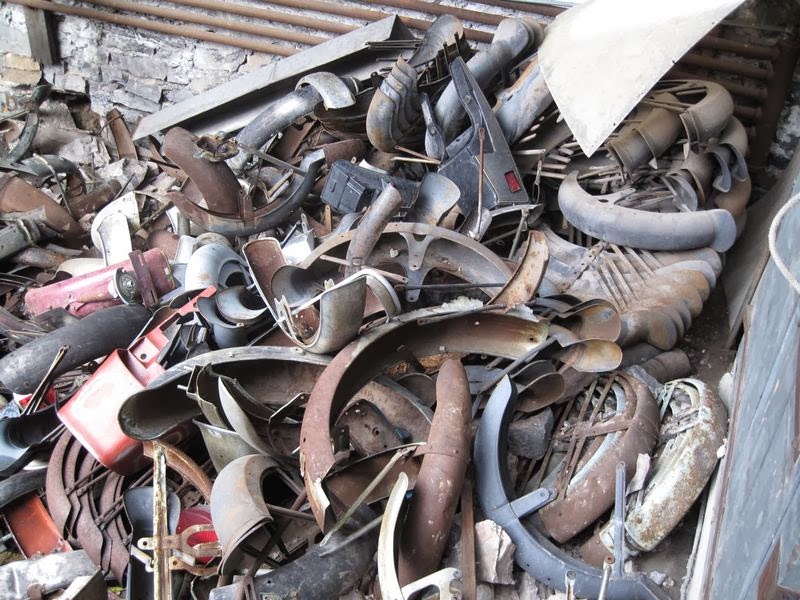
Around 1997 Kohl sold the building and motorcycles to "Frank", who operated the business as Kohl’s Cycle Salvage, selling parts off of the hundreds of motorcycles. Although he had begun paying the back taxes, the interior of building was now falling apart and the roof was caving in.With Frank unable to afford repairs the City of Lockport condemned the building, and it basically became an open picking grounds for anyone in the know. With the building condemned Frank didn’t see a reason to continue paying taxes, and the city also assumed ownership of all of the contents of the building.
Walter Kohl died in 2002 at the age of 82 . Frank successfully sued the City of Lockport for ownership rights to the contents of the building and was issued a deadline of mid November 2010 to remove the contents. By October Frank had begun scrapping motorcycles.
On Tuesday July 30th, 2013 Lockport Police and Fire departments received a 911 call reporting a fire at 71 Gooding Street. At about 2 p.m. the building's north wall collapsed. Three people, believed to be in their teens, were seen running from the building shortly before flames broke out.
BTW, if any of my readers want to donate old biker magazines to a good cause (i.e. enhancing my soggy gray matter) please drop me an email at charvin23@gmail.com. English language reading/reference material is in pretty short supply out here and thanks to the EU even Google is rapidly becoming useless. ;)
References:
Original article by Dynamite Dave
Historic Lockport building to be demolished in wake of fire
Flickr photoset by Chris Luckhardt
Weird tale in Lockport parts 1 and 2
newboards.tusclan.com
http://www.flickr.com/photos/colink/sets/72157623586414532/detail/
Subscribe to:
Posts (Atom)


+12-08+933495725b6bf0a9.jpg)
+12-08+933495725c801f85.jpg)