Showing posts with label moto guzzi. Show all posts

3.27.2012

The BMW Schneekrad and Other Mechanical Weirdness

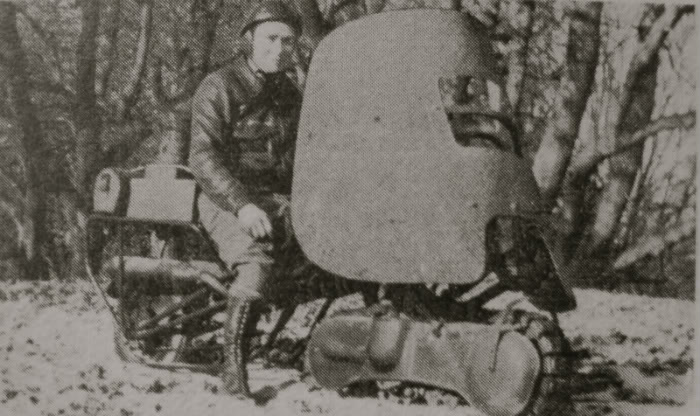
Some time back a friend of mine posted a strange photo on my Facebook page; a track-mounted BMW sidecar machine that was so mechanically bizarre that my first comment was "Photoshop". That comment was premature: further digging showed that it was indeed an actual machine, the BMW Schneekrad.
I was already familiar with the Kettenkrad of course, but this thing seemed to be so far into the realms of "concept bike" that I started wondering what else had come out of the design labs...


The "Schneekrad" prototype snow machine was built in either 1936 or 1939 by BMW engineer Riemerschmidt, using a BMW R-12 engine in a "Gleitkettenkraftrad" or "slip-chain" (?) motorcycle design and a Steib TR-500 sidecar. There is almost no further information on the machine that I can find, which leads me to believe it was a hastily abandoned project with perhaps only a single prototype built.

The diagram appears to be completely infeasible unless there are two separate tracks with the operator mounted between them: yet the photos appear to show a single track which runs beneath the rider and fuel tank. Most likely Riemerschmidt was simply experimenting with the design using whatever pieces were at hand rather than demonstrating a finished prototype, but if anyone has more information on this oddity please let me know.


Tracked motorcycles were neither new nor unique to BMW of course; the British Osborn Engineering Co. (Gosport, Hants) prototyped a tracked motorcycle as early as 1928 and Victoria-Werke AG. experimented with an inline design (replacing the rear wheel with a track) 3 seater in the 1930's as well.


1937 Mercier Type 3 Tracked Motorcycle
On February 9, 1937 the French Army tested a "Type 3" tracked motorcycle designed by Adrien Mercier, a Swiss citizen living in Bois-Colombes. The machine used a front mounted J.A. Prestwich 350cc, 11hp. engine with a 3 speed transmission; according to most sources only 3 prototypes were built, but it seems there may have been more as one was actually sold on E-Bay as recently as 2009.


In fact the French were quite serious about their combat motorcycles, and came up with several intimidating designs. Another notable vehicle was the Vespa 150 TAP (Truppe Aero Paracadutate), the familiar Italian scooter (in this case produced under license in France) modified to transport a U.S. made M20 75 mm. recoilless rifle. The recoil in this particular cannon is counteracted by a rear gas venting system which eliminated the need for mechanical recoil suppression or heavy mounts, and technically enabled it to be fired from the lightweight Vespa frame.


While the mental image of an offensive line made up of French bazooka mounted scooters is enough to cause any likely opposing force to immediately retreat in fear of losing their sanity, the reality is that the M20 doesn't include an aiming device.
In fact the plan was for the scooters to be parachute-dropped in pairs accompanied by a two-man team; the gun was carried on one scooter while the ammunition and a tripod were loaded on the other, and the Vespas were simply meant to be a cheap, lightweight transport rather than an actual firing platform. Approximately 800 of these scooters were deployed in the Algerian War during the late 1950's.


Of course the best known (and probably most successful) attempt at a tracked motorcycle design was the famous Kleines Kettenkrad HK 101 (SdKfz 2), a half-track vehicle with a motorcycle front end which NSU produced for the Wehrmacht from 1940 to 1945.
Designed by Praxl Ewald and Ernst Schmidt, the Kettenkrad basically consists of a self-supporting sheet steel tub with dual caterpillar drives. The centrally mounted, water cooled, four cylinder in-line OHV engine was manufactured by Opel and produced 36 bhp at 3400 rpm: top speed was 70 km/h (44mph).


The driver sits on a standard motorcycle saddle mounted above the forward gearbox and two rear facing passenger seats were installed behind the engine, although this proved to be somewhat of a disadvantage in combat situations as the passengers had no emergency access to the steering. The steering itself is unique in that the front motorcycle wheel was generally used for light turns but a sharper turn actually engaged the track brakes to turn like a traditional tank. In fact it was recommended to remove the front wheel altogether in especially heavy terrain.  


The Kettenkrad proved an effective off-road and general utility vehicle despite the fact that it was relatively expensive to produce and maintain (the tracks alone have 80 lubrication points which need to be greased every 500 miles), and they saw extensive service especially in the deep mud and snow of the Eastern Front. Around 8800 Kettenkrads were built during the war, with another 550 produced post-war (up to 1951) by NSU for agricultural use.


Moto-Guzzi Mulo Meccanico

The Italians developed a similar vehicle -the "Mulo Meccanico"- in 1960, but unlike the Kettenkrad the Mule was designed more as a three wheeled trike: the tracks are accessories driven by the rear tires. Powered by a Moto-Guzzi 754cc. V-twin, it has 3 wheel drive and a 6 speed gearbox with a max speed of around 50 km/h.

Soviet NKL-26 Aerosani


Snow of course has always proved a challenge to military vehicles, and various armies have come up with some unique concepts for dealing with it. One of the most visually interesting was the Russian NKL-26 Aerosani; a lightweight plywood box with ten-millimeter armour plate on the front and armed with a 7.62mm DT machine gun in a top mounted ring. It was powered by an M-11G aircraft engine, and could reportedly reach speeds up to 25–35 km/h in deep snow, where most other vehicles couldn't move at all. Each NKL-26 was operated by two crewmen, and could carry four ski troops riding outside the vehicle on its skis.


An interesting note on the NKL -and one which ties into my old stomping grounds back in Michigan's U.P.- is that there is some evidence that the Soviets obtained plans for "air sleighs" as early as 1924 from one Chester B. Wing, an aviator, automobile dealer and former mayor of St. Ignace, Michigan, U.S.A. He had built practical aerosleds to run across the ice between St. Ignace and Mackinac Island: the Spring 1943 issue of the magazine Science and Mechanics states that "from his aerosleds the Russians developed their present battle sled", although that claim has to be viewed in the context of a picture of an Igor Sikorsky machine in Kiev pre-WWI. Multiple designs of the propeller driven snow machine were used during WWII, including a an ASD-400 heavy assault sled.


 On the face of it, screw drives were a less than obvious solution to winter mobility but one which was widely experimented with nonetheless. As early as 1907 Ira Peavey of Maine patented a tractor designed for hauling logs with two articulated augers: The prototypes reportedly worked well on hard packed snow but failed in soft powder because the flanges had nothing to grip into. Armstead Co. of Detroit developed the Armstead Snow Motor in the 1920's, which consisted of two screw cylinders fitted to a Fordson tractor: a promotional film shows the machine hauling 20 tons of logs and it apparently had some production success.


Raedel Schraubenantrieb Schneemaschine, 1944
In 1944, Johannes Raedel, a German veteran of the Eastern Front invented the "Schraubenantrieb Schneemaschine" (screw-propelled snow machine) and convinced the OKH in Berlin to allow him to build a prototype. He was dispatched to the Austrian Alpine Vehicle Test Center in Tyrol and presented a working model on April 28, 1944. It was tested extensively, and although very slow it could pull up to one ton and reportedly possessed good climbing capabilities. But it was incapable of penetrating drifts or snow piles, and Raedel's machine never went into production.


Above: ZiL 4904 Heavy Amphibious Vehicle

ZiL 2906

 
Russian Twin Screw Snowmobile Prototypes

Russia experimented with various screw driven machines, and heavy truck manufacturer ZiL (Zavod imeni Likhachova) built several models, the most famous of which may be their 1975 amphibious screw propelled  ZIL-2906, designed specifically for recovering cosmonauts who landed in inaccessible areas. This machine used two Venyukovsky 2103 engines with each driving a separate worm conveyor: steering was accomplished by reversing one screw while locking the other.

1969 Navy RUC

Around the same time the American Waterways Experiment Station tested a "Marsh Screw Amphibian" designed by Chrysler. The counter rotating screws "...propelled the vehicle through water and marsh terrain adequately, but failed miserably on soil surfaces, especially sand". The average max speed was a meager 1.6 miles per hour, but despite this Chrysler went on to produce a much larger "Riverine Utility Craft" (RUC) for the Navy in 1969. The RUC travelled on two 39 inch (991 mm) diameter aluminum rotors and achieved impressive speeds of 15.7 knots (29.1 km/h) on water and nearly 25 knots (46 km/h) on marsh. But speeds on firm soils still proved disappointing and the vehicle would get stuck crossing dykes; the same problem Raedel faced.

"Ice Challenger" Snowbird 6

In 2002 the British "Ice Challenger" expedition used an amphibious screw vehicle known as the Snowbird 6 to cross the Bering Strait: although the expedition was ultimately unsuccessful due to Russian politics, the vehicle performed well and they managed to overcome the inherent difficulty of climbing banks by installing a system to raise the cylinders exposing conventional caterpillar tracks.


There's plenty of other weirdness out there of course, and as long as mankind is able they'll certainly continue to attempt reinventing the wheel. And cheers to them. I can't help but wish many of these prototype machines had proven more successful; no matter how cool your Polaris "Assault" is, that '36 Schneekrad is WAY cooler.


References:

NSU Kettenkrad

In Soviet Russia Cars Screw You: fulgerica.com

Soviet Snowmobile Information from trinixy.ru


5.17.2011

Moto Guzzi


From top: Carlo Guzzi,
Giorgio Parodi, Giovanni Ravelli 
Carlo Guzzi was born in Milano in 1889, and as a young man he frequented the workshop of blacksmith Giorgio Ripamonti in Mandello del Lario on annual holidays to Lake Como. Guzzi was fond of mechanics and Ripamonti was constantly working on the engines of local boats as well as any of the early model bikes and cars that made ​​their appearance on in the town; sometime in these early years Carlo developed the idea of building his own motorcycle, an idea no doubt strengthened through his studies in the technical schools of Milan. After his graduation and qualification as Chief Engineer he went to work for luxury car manufacturer all'lsotta Fraschini, but the First World War intervened. He was drafted into the Royal Italian Air Force, joining the Venice based Miraglia seaplane squadron as a mechanic.

During the time he was stationed there he became close friends with two pilots; Giovanni Ravelli, an acclaimed aviation instructor and motorcycle racer, and Giorgio Parodi, the son of wealthy Genoese ship-owners. Together they reinvigorated Guzzi's old dream and made plans to start their own motorcycle company after the war with Carlos designing the machines and Giovanni promoting them through racing. Giorgio would assist with the financing.

Unfortunately Giovanni Ravelli was killed in a plane crash on August 11 1919, but soon after that Guzzi and Parodi returned together to Mandello. They approached Guzzi's old friend Giorgio Ripamonti with designs for a motorcycle which incorporated innovations that Guzzi had drawn from his wartime experience with aircraft engines. Giorgio's father gave them an initial loan of two thousand lire to finance the project and in 1920 Ripamonti finished work on the prototype G.P.(Guzzi & Parodi), featuring a four stroke 500cc horizontal single cylinder engine with a unit construction gearbox and the hallmark exposed “bacon-slicer" flywheel. Unlike many common motorcycle designs every component of the G.P. was rational and essential; their primary goal was functionality and reliability, but from the beginning they had designed the machine for racing  competition. That first prototype, radically different from other bikes in its engine configuration and low-slung frame, met their goals admirably.

When they presented the bike to Giorgio's father, Emanuele Vittorio, he agreed to finance the company. On March 15, 1921 Carlo Guzzi and Giorgio Parodi along with Giorgio's brother Angelo founded the "Società Anonima Moto Guzzi." For their logo they chose an eagle with outstretched wings as a tribute to their lost comrade Giovanni Ravelli.

In 1921 the Normale was born. This was their first commercial model with 8 hp, a maximum speed of 80 km/h and a fuel consumption of 30 km per liter. Notably, the Normale was the first bike in the world to be fitted with a center stand. Carlo Guzzi's horizontal single engine design dominated the first 45 years of the company's history, and until 1934 each engine actually bore the signature of the mechanic who built it.

1921 Normale

As originally envisioned the company used racing to promote the brand. Carlo Guzzi made his racing debut on May 28, 1921, entering the Milan-Naples race with the only two motorcycles they had: they took 20th and 21st place. Only four months later Gino Finzi's Guzzi won a sensational first place at the famous Targa Florio. In the 1935 Isle of Man TT, Moto Guzzi factory rider Stanley Woods took a double victory with wins in both the Lightweight TT and Senior TT.

In contrast to the traditional horizontal four-stroke single cylinder 500 cc engines outfitted with both overhead and side valves (IOE, inlet over exhaust or F-head), the company supplied the official racing team and private racers with higher performance racing machines with varying overhead cam, multi-valve configurations and cylinder designs.
Alce


In 1938 the Alce (Italian for Elk) was presented to the military as a primary machine for reconnaissance and escort convoys. An improvement over the earlier models it retained the latest 13.2bhp overhead exhaust and side valve engine but had an automatic oil pump, an improved frame with higher ground clearance and changes to the exhaust system which enabled it to operate in a variety of wartime conditions. The motorcycle was also produced -perhaps more famously- as a three wheeled cargo vehicle known as the Trialce which was designed to be easily disassembled and dropped by parachute.

Trialce

Initially the Alce was used almost exclusively by dispatch riders but its reliable, rugged design was quickly adapted for use as a reconnaissance vehicle and mounts were added for light machine guns and artillery pieces for rapid incursion and infantry support functions. It gained legendary status in the army and bore the remnants of the Italian armies on their homeward journey, not just metaphorically but in many cases physically, from the African Sahara to the Don river front in Russia. The Alce continued in production until 1958 even though it had been supplanted in 1946 by the Superalce.

The period after World War II was as difficult in Mandello del Lario as it was elsewhere in post-war Europe. As motorcycle popularity waned, Moto Guzzi's solution was production of inexpensive, lighter machines. The 1946 "Motoleggera", a 65cc bike became very popular along with the four-stroke 175cc "Galletto". Still, Moto Guzzi was limited in its attempts to break into this market as other already established Italian scooter manufacturers such as Piaggio (Vespa) and Lambretta quickly made it clear that they wouldn't tolerate the added competition; in fact when Guzzi unveiled their prototype for a small wheeled scooter Lambretta retaliated with a prototype for a V-twin motorcycle, threatening to directly compete on Moto Guzzi's own turf. The two companies compromised: Guzzi never produced their scooter and Lambretta never manufactured their motorcycle. Curiously though, the Lambretta prototype very closely resembled Guzzi's later famous V twin.


Between 1921 and 1957 Moto Guzzi had 3,329 successes, 11 Tourist Trophies, and 14 World Championship Titles. Guzzi led the world of Grand Prix motorcycle racing in the 1950s, and with Carcano designed 250 cc and 350 cc bikes they dominated the middleweight classes. But ultimately Moto Guzzi (and their main competitors Gilera and Mondial) withdrew from racing after the 1957 season due to escalating costs and diminishing motorcycle sales.


By 1964, the company was in full financial crisis. Emanuele Parodi and his son Giorgio had died, Carlo Guzzi had retired to private life, and direction passed to Giorgio's brother Enrico Parodi. Carlo Guzzi died on 3 November 1964 in Mandello.
In February 1967 state controlled receiver SEIMM (Società Esercizio Industrie Moto Meccaniche) took ownership of Moto Guzzi and began adapting to a cultural shift from motorcycles to automobiles by focusing on lightweight mopeds which had become popular with consumers. But it was during these SEIMM years that Guzzi developed the 90° V twin engine which would become icon of the Moto Guzzi brand.


Though Moto Guzzi has employed engines of myriad configurations, none has come to symbolize the company more than the air-cooled 90° transverse head V-twin. The original V was developed in the early 1960s by engineer Giulio Cesare Carcano; the machine began life with 700 cc displacement and 45 hp (34 kW) and was designed to win a competition for a new police bike sponsored by the Italian government. The sturdy shaft-drive, air-cooled motorcycle not only won, it gave Guzzi  a renewed competitiveness. This 1967 Moto Guzzi V7 with the original Carcano engine has been continuously developed into the 1,200 cc, 80 hp (60 kW) versions offered today (2006). Lino Tonti redesigned the motor for the 1971 Moto Guzzi V7 Sport. This engine is the basis of the currently used 750 cc, 1,100 cc and 1,200 cc Guzzi engines.

Moto Guzzi introduced the California models in 1972, based on a design sold to the Los Angeles Police Department. The California remained popular throughout the 1980s and 1990s and remains in the US Moto Guzzi range as the California Vintage. In 1973 De Tomaso Industries Inc. (D.T.I. Group or DTI) purchased SEIMM (and thereby Moto Guzzi) along with Benelli and Maserati. Under Tomaso's stewardship Moto Guzzi returned to profitability; in 1976 Guzzi released the 850 shaft drive Le Mans cafe race. Six versions of the Le Mans have been produced; the Le Mans II and III are 850cc, the IV and V are 1,000cc and the V11 machine is 1,064cc. The first two models had rounded air cooling fins on the cylinders while the latter have squared fins, a detail used to distinguish them. Early models use 36 mm or 40 mm Dell'Orto carburetors but the late model V11 Le Mans is fuel injected: all the machines in this series are highly regarded for their styling and performance.


In April 2000 Aprilia S.p.A acquired Moto Guzzi for $65 million but the arrangement would remain short-lived as Aprilia itself stumbled financially. The Moto Guzzi assembly line closed for a short period in March 2004 due to the financial difficulties, but in December 2004 Piaggio & Co. acquired Aprilia and Moto Guzzi forming Europe's largest motorcycle manufacturer. Piaggio's investments have allowed introduction of a series of competitive new models in rapid succession.


2011 brings the celebration of the 90th anniversary of the Moto Guzzi brand, and today Moto Guzzi  is the world’s second oldest continuously operating motorcycle manufacturer (after Royal Enfield).  Throughout its history, Moto Guzzi has earned approximately 3,300 racing wins, including 14 world GP titles, 22 world records and 11 Isle of Man Tourist Trophy wins.


References:

Life in Italy.com: History of Moto Guzzi
liarsroma.com: Carlo Guzzi
Moto Guzzi Club Malta
Moto Guzzi USA
Squadra Guzzista: Superalce
Moto Guzzi Heritage.com (90th Anniversary Website)
Selected photography from Cyclegarden.com