Showing posts with label scooter. Show all posts

3.04.2013

Simson


In 1854 German brothers Löb and Moses Simson bought one third of a steelhammer works in Suhl, founding Simson and Co. two years later to focus on production of carbon steel. Over the next decade the factory gained a reputation for their guns and gun barrels; in 1871 they installed their first steam engine and by 1896 they had begun expanding their operations into the production of bicycles.

In 1907 Simson Co. began automobile production with the "Simson A", but the war intervened in the automotive business and the company quickly reverted to their more lucrative contracts in arms manufacture, turning out Mauser Gewehr 98 rifles for the German Army. After the Treaty of Versailles the reorganized Reichswehr was restricted to buying handguns from a single company in order to limit the recovery of the arms industry; larger manufacturers such as DWM were passed over in favor of Simson precisely because of its lower production capacity, and as such Simson was the sole producer of military-contract Luger pistols from 1925 to 1934. Along with their Luger model Simson also was responsible for repairing and refurbishing the Reichswehr's existing Gewehr 98 and Karabiner 98b rifles, MG08 machine guns and MP18 submachine guns. 
Simson Model 1922

Beginning in the 1920s Simson also produced the .25 ACP Westentaschenpistolen ("vest pocket pistols") their only venture into commercial handgun production until 1989. These pistols were available in two almost identical models, the first known as Model 1 in German and Model 1922 in the United States, and the second as Model 2 in Germany and Model 1927 in the US.
 
From 1914 to 1915 Simson restarted limited automotive production with a four-cylinder 1.5 liter, 22hp. model A and a 2.6 litre, 28hp model C. Production was placed on hold again until 1919, when the company finally resumed their model line with a new 1.6 liter 22hp model Bo, the 1.6 liter 40hp model Co and a 3.5 liter, 45hp model D. Top speeds were 80 km/h (50 mph) for the Co and 90 km/h (56 mph) for the D. In 1923 Simson replaced the D with the 3.6 litre, 65 bhp model F, their first 100 km/h (62 mph) production model. In 1924 the range of cars was completely revised and redesigned by Paul Henze and given the Simson-Supra name.

Simson SO

1925 Supra SS
The first Supra models were the S and the S Sport, with a four-cylinder, two liter long-stroke DOHC engine. The S produced 50hp and had a 120 km/h (75 mph) top speed; Sport had 60–80hp and a top speed over 140 km/h (87 mph). In 1925 a SOHC So version was introduced. The S and S Sport were discontinued in 1926 while the So continued until 1929. In 1925 Simson introduced the model J, its first six-cylinder car; it was succeeded in 1926 by the model R, with an OHV pushrod engine.
In 1931 the model RJ was introduced with 3.3 litres displacement and 70hp; that same year Simson introduced the first and only eight-cylinder Supra, the Supra model A. Its engine shared the RJ's long-stroke dimensions of 79.5 x 115 mm, giving it 4.7 litres displacement. This produced 90 bhp and gave a 120 km/h (75 mph) top speed. 


The Simson family was Jewish, and with the rise of Hitler's Nazi party in in 1936 they were forced to flee Germany. Under the laws dispossessing Jewish industrialists a trustee took control of the firm, and it was merged with other factories to form the Berlin Suhler Waffen- und Fahrzeugwerke (BSW). That same year the factory produced its first motorcycle, the BSW 98, which had a 98 cc engine and two-speed transmission. Critics of the Nazi government suggested a different meaning for the BSW initials: Bis Simson Wiederkommt ("until Simson returns"). During the war the factory increased weapons production under the title Gustloff-Werke – Waffenwerk Suhl, named after assassinated Swiss Nazi Wilhelm Gustloff. Sachs-engined motorcycles from 47 cc to 123 cc were made within the Gustloff group from about 1934 until about 1940 and continued to build bicycles, weapons and cars until 1945.


1951 AWO 425
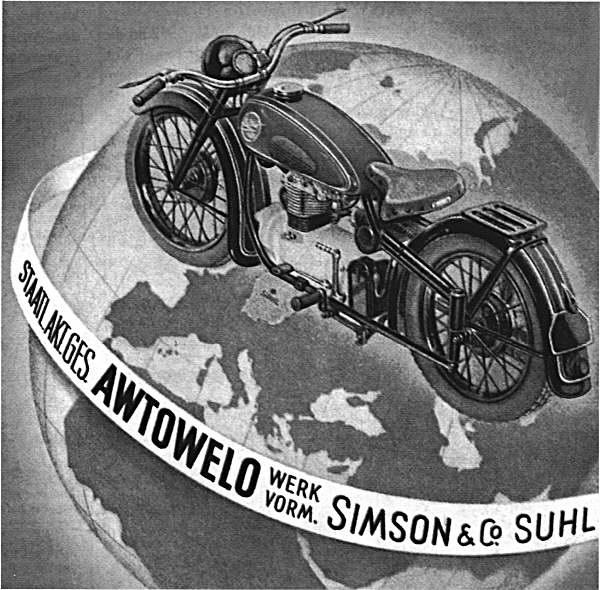
In 1946, by order of the Soviet Military Administration in Germany the manufacturing plant was partially dismantled and transported to the Soviet Union (USSR) as part of the Soviet reparations program. In 1947 the factory was integrated into the Soviet Sowjetische Aktiensgesellschaft Awtowelo (SAG Awtowelo or "Soviet Avtovelo Company Limited"). Initially all production was for export to the USSR, however the Soviets later handed control of the factory to the German Democratic Republic (DDR) and in 1952 it was renamed Volkseigener Betrieb Fahrzeug- und Gerätewerk Simson Suhl. Production of sporting guns, prams and bicycles slowly resumed, but the main focus was now on making motorcycles.


AWO 425 with Stoye sidecar, arguably one of the most beautiful motorcycle combos ever made.


Between 1949 and 1962 the Suhl factory produced more than 209,000 four-stroke motorcycles designated 425 (four-stroke engine with 250 cc displacement). The motorcycle featured overhead valves in a V-formation, four-speed transmission, shaft final drive and a duplex cradle frame: the 12hp engine produced a top speed of 100 km/h (62 mph). Branded the AWO (an abbreviation of Awtowelo)  it earned a high reputation in the Eastern Bloc countries from 1949 until 1955, when the Simson name was finally revived. Some had Stoye sidecars fitted, and a Stoye Campi luggage trailer could also be fitted.
The first 1,000 machines built from July 1949 until December 1950 were exported to the USSR, then  released to the DDR domestic market in 1951.
In 1955 Simson introduced  the 425 S (Sport) model with twin-shock swing arm rear suspension and a top speed of 110 km/h (68 mph). Initially the 425 S had 7.2:1 compression and produced 14 bhp;[19] in 1961 this was increased to 8.3:1 which increased power output to 15.5 bhp. The 425 S ran from 1955 until 1962, with a total of 85,000 built.

Late model (post-1958) twin 250cc

In 1953, 15 AWO 425 R. racing machines were built. A version with chain-driven double overhead camshafts appeared in 1955 and produced about 28hp. But by 1958 Simson's racing team found it necessary to switch from shaft drive to chain drive, which meant that it had to develop a new engine as well. Alongside their proven single cylinder engine, Simson also developed a 250 cc parallel twin that produced more than 30 bhp at 10,000 rpm. Like the single, the twin's valves were in a V-formation and it had a six-speed transmission and chain final drive. The twin was introduced with chain driven double overhead camshafts, but for the following season the engine was revised with shaft-driven overhead cams.
Simson also developed a new motorcycle frame for racing, with a leading link front suspension and long swingarm rear suspension.

The Simson twin proved fast but the bike was plagued with teething troubles; MZ won numerous international victories in the 1950s, but Simson's wins were confined to domestic competition. Simson won the DDR-Meisterschaft ("GDR Championship") in 1953, 1954 and 1955,  but in 1958 the Allgemeiner Deutscher Motorsport Verband (ADMV, "General German Motorsport Federation") decided that in the 1959 season works riders would not be allowed to compete in the national championship.


 A Geländesport ("Enduro") version of the swinging-arm framed S model (425 GS) was introduced in 1957 and about 80 examples were built until 1959. Simson then developed a version of its single-cylinder engine enlarged to 350cc for Enduro and Motocross competition:  the enlarged GS engine provided such good performance that Simson expanded production for competition machines.
In its first years of competition the GS suffered numerous competition defeats, but Simson systematically improved its reliability. By the time four-stroke production was ended at the end of 1961 the Simson works team had won competitions both in the DDR and abroad, and because of its competitiveness and reliability the GS model was used to equip the DDR's national Six Days Trial team.

Simson factory, 1959

In the early 1960s the DDR introduced a policy of Kapazitätsbündelung ("capacity concentration"), under which the production of larger motorcycles would be concentrated at the MZ works at Zschopau. The DDR's Volkswirtschaftrat ("People's Economic Council") terminated Simson four-stroke manufacture in December 1961 and from January 1962 all new private cars and motorcycles had to be two-stroke.


Above: Simson SR
KR50
But Simson had already been producing two-stroke mopeds since 1955; their first model was the SR 1, a 48cc machine producing 1.5 hp. In 1958 Simson launched the KR 50, with integral leg shields and a rear wheel enclosure like a motor scooter, but 16-inch (410 mm) wheels like a small motorcycle. The KR 50 had a 48cc motor like the SR-series, but with a higher compression ratio that increased power output to 2.1hp.  When four-stroke motorcycle production was terminated, the Simson factory increased the KR 50's power to 2.3hp. In 1964 this model was succeeded by the KR 51 Schwalbe ("swallow"), increasing power by almost 50% to 3.4hp. Moped production grew steadily in Suhl; up to 200,000 mopeds were built per year and in 1965 the Simson factory employed 4,000 workers.


In 1968 Simson was merged with VEB Ernst-Thälmann-Werk Suhl to form the VEB Fahrzeug- und Jagdwaffenwerk Ernst Thälmann Suhl. The Schwalbe helped the company to worldwide fame, and in the DDR the scooter stood for the success of East German two-wheeler motor manufacturing.
That same year the KR 51/1 series was introduced with power increased to 3.6hp, followed in 1979 by the KR 51/2 series with 3.7hp. Schwalbe production was ended in 1986 in favour of more modern 50cc moped models. In 1970 Simson introduced a bicycle-style, pedal-start moped, the 50cc, 1.6 bhp SL 1 Mofa.  In 1975 Simson revised its image with a new model, the S 50 which was produced in various versions until 1980. Its successor was the S 51, in which Simson revised the styling again and returned to a long-stroke engine, this time with 38 x 44 mm dimensions and a 3.7 bhp output. The S 51 was built in various forms until production was ended in 1990.


After East Germany's Peaceful Revolution in 1989 and German reunification in 1990, a number of attempts to modernize the assembly lines were made, including commercial production of Makarov PM pistols but fewer than 1,000 commercial Makarovs were made under the Simson name before production was discontinued.


S51

In 1990 the S 51 and S 70 models were revised as the 50cc S 53 and 70cc S 83, but total production from 1990 until 1994 was only about 10,500 machines. In 1992 Simson resumed tricycle production with a 50cc, 3.3hp  SD 50 LT, based on the SR 50 scooter but with a single seat and 360-liter cargo space behind it. The model was named the Albatross, and production continued until 2002.
In 1993 the Suhl factory began making the Hotzenblitz electric car under contract for Hotzenblitz Mobile GmbH and Co. KG of Ibach in Baden-Württemberg. The car had two seats and weighed 780 kg (1,700 lbs.), producing only 16 bhp with a range of only 100 km. The car had little success and only 140 were built until production ended in 1996. The SR 50 and SR 80 scooters were revived that same year.


SR50
Serber Sport

In 1996 Simson revived the Star name for a new 50 cc scooter with more curvaceous, fully enclosed bodywork. The company also introduced a 5.1hp version of the 50cc machine, renamed the Sperber.  In 1999 the Sperber Sport with a full sports fairing was released, along with a new model Spatz with a space frame. In 1998 Simson introduced a 125cc model, the Shikra, powered by a Honda four-stroke 15 bhp engine built under licence in Taiwan. In 2000 the Shikra name was discontinued, power output was reduced to 13.6 bhp and the model became simply the Simson 125.

Although several investors tried to keep production going and to bring new developments on market, but after the political changes in East Germany in 1989 numerous attempts to modernize the assembly lines failed. but production finally ceased in autumn 2002. On February 1, 2003 bankruptcy proceedings were held, in the wake of which the remaining 90 employees were made redundant without any compensation. The Schwalbe has since gained cult status in western Germany and the AWO models are increasingly popular throughout Europe.


References:
simson-moped.de
Simson at autoevolution.com
Suhl Fahrzeugmuseum
Photography from mza-portal.de via N24.de

7.07.2012

The Cushman Motor Company


The Beginnings
Everett (left) and Clinton Cushman
In 1901 cousins Everett and Clinton Cushman of Lincoln, Nebraska applied for a patent on a seal to prevent compression leaks on small two-cycle stationary engines. They'd been building and working on farm machinery for some time; both had attended the University of Nebraska and although the younger Everett had "...went in the front door and out the back" according to his grandson Robert, Clinton graduated with a degree in electrical engineering in 1902. 
That same year their patent was approved, and the duo filed articles of incorporation as the Cushman Motor Company on September 18, 1902.

 Working out of the basement of a building on the northwest corner of 24th and O streets, the pair struggled to make a living from building engines for farm applications. At the same time they were both avid boaters- a difficult prospect in landlocked Lincoln- and were constantly working on modifications for a marine engine. When Everett saw an advertisement for a single-cylinder outboard engine competition the cousins entered a 2hp version of their two stroke and took first place. The Rudder, a popular power boating magazine, ran an article about the race which gave the Cushman engine some much needed PR, and they began to develop a reputation for power and reliability. But the overall demand simply wasn't enough to make Cushman a major name.

Early Cushman 2hp Outboard
Advertisement from 1919 Nebraska Farmer
By 1906 the company was struggling to stay afloat and the next three years saw little in the way of advancement. But in 1909 the cousins brought in Everett Brown Sawyer, a young salesman with a strong background in engineering. As general operations manager Sawyer quickly realized the growth potential in the agricultural market: farmers were actively seeking new means of mechanizing production. Clinton and Everett were persuaded to put their marine line on the back burner and developed a new line of 4 stroke, high speed water cooled engines which developed a solid reputation around the Midwest. In 1910 the company turned an actual profit of $12,000 and was incorporated as the Cushman Motor Works: in 1913 they broke ground on a new foundry and factory on 21st Street in Lincoln.

World War I opened new military and foreign markets, along with a dramatic increase in demand for electricity; with some modifications to their 4hp binder engine Cushman began producing portable "electric light plants", small enough to be popular with individual farmers but also in demand from small electric companies and the government. By 1918, sales had risen to $1.5 million and the company opened a Canadian branch in Winnipeg, Manitoba; Cushman engines were powering everything from hay presses to washing machines.

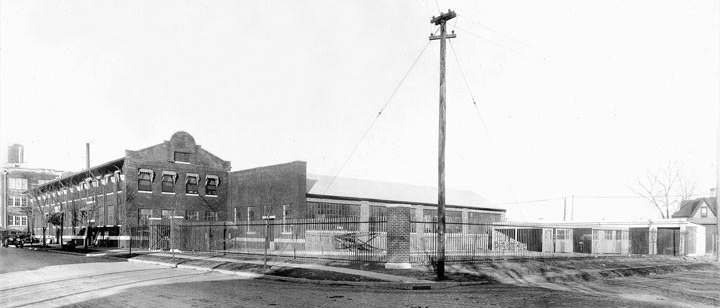
Cushman Motor Works, 1919
 But the drop in military contracts at the end of the war coupled with the farm depression in the early 1920s signed a death knell for the company: despite a line of new engines even Sawyer was unable to pull sales back up. Everett Cushman left the company in 1919 to start the Cushman Engineering Company in California with his son Clifford, then later joined Piersen Manufacturing Co. in Topeka, Kansas. Clinton Cushman's fate after 1919 is unknown. Everett Sawyer ran the company himself until was forced out by creditors in 1927, when a management firm controlled by outside creditors took control.

Easy Manufacturing


Cushman R-1, 1936
In 1933 Charles Ammon was running the Easy Manufacturing Company in Lincoln, just down the street from the Cushman Motor Works (the Cushman foundry had been a major supplier of castings for Easy).
The onset of the Great Depression allowed Ammon to acquire the remains of Cushman at a bargain and they quickly adopted the Cushman name for their own line of small multi-purpose engines, capitalizing on the already established reputation.
About 1935 the new company bid on a contract to supply scooter motors to the California-based Motorglide Company. Ammon lost the original bid, but he had learned enough to conclude that there must be a market for scooters and by October 1936 the first Cushman scooter prototype, the R-1, was ready for production. Renamed the "Auto-Glide", the machine featured a 1 hp. (11⁄2 hp. optional) Cushman "Husky" 4 stroke with a wet clutch system, primitive automatic transmission, chain drive and an advertised top speed of about 30mph.

The Stooges on an early Cushman sidecar machine
With the addition of the optional "Kari-Pac," a sort of bin which attached to the rear, the scooter found commercial use as a small delivery wagon that could hold up to 100 pounds. Although initial sales were low the company soon began offering a variety of new options including larger engines and cargo boxes in various configurations, including a sidecar and a front end delivery box. One of the more elegant designs was the "Kar" model 29, a 3 wheeled full chassis vehicle introduced in 1939. Their 3 wheel design would later prove to be the company's most successful configuration.

 1939 Kar model 29 

Second World War
After America officially entered World War II in 1941, Cushman was one of the few manufacturers of motorized vehicles allowed to continue civilian production: the carts and scooters were considered "energy savers" for those needing efficient transportation to jobs. While the factory began production of bomb nose fuses (over 8.5 million produced during the war, and given the Army and Navy "E" awards for outstanding quality and quantity), the military also found an immediate need for lightweight, dependable and economic transport both on base camps and in the field. More than 15,000 Cushman two and three-wheeled vehicles were commissioned for use by all branches of the armed forces.

 
1944 Cushman Airborne, Model 53

In 1944 the Model 53 Cushman Airborne was introduced: a heavy 255lb. rigid framed machine with a stock 4.5 hp "Husky" motor and non-syncromesh 2 speed sliding gear transmission. The Airborne's top speed was 45 mph, but the heavy, solid frame produced a bone jarring ride on anything besides smooth tarmac.
The machine was designed to be airdropped by parachute or carried by glider, and it had a hitch to pull a model M3A4 general-purpose utility cart. The cart could be converted to carry .30 or .50-cal. machine guns or an 81mm mortar, though performance was sketchy under any kind of heavy load.

Reportedly the Army engineers also made a serious weight miscalculation when allocating the parachute size for the Cushman, and as a result the scooter hit the ground with enough force to bend the frame in half.
Utilizing typical "Army intelligence", rather than simply using a bigger parachute they contracted Cushman to modify the Airborne with a large spring-loaded bumper that wrapped around the frame section of the scooter, adding another 50 lbs. in the process. This resulted in an Airborne with bent frames and bumpers, hardly the improvement they were seeking. The whole parachute program was scrapped, but Cushman still made nearly 5,000 airborne scooters for the military. The rugged, simple Model 53 could travel through a foot of water, climb a 25 percent grade and had a range of about 100 miles. After the war the Airborne was modified with swing-arm rear suspension and sprung trailing link forks, and sold on the civilian market until 1954 as the model 53-A. Many of them were re-purposed for use by the postal service and police departments after the war.


Post- War Production
1948 Pacemaker
Following World War II, Company President Charles Ammon started a union in an apparent attempt to block worker support for outside union representation. But in 1946 the Cushman factory workers chose the UAW-AFL to represent them, and the first one-year contract was signed Nov. 14, 1946. In 1947 control of the company passed from Charles Ammon to his sons; Robert, who became president, and William who served as vice president. Soon after Robert Ammon became president the plant converted to a small-scale assembly line modeled on Detroit's auto manufacturing principles; Ammon told Business Week magazine in 1950 that he liked to think of Cushman as "...the General Motors of scooter production". Several new models were introduced to the production line from 1946 through 1950, including the Pacemaker and Roadking models (1946), the Sears Allstate (1948) and the Highlander (1949).


 Above: Bo Diddley with a Cushman RoadKing


  Above left: Cushman Allstate (manufactured for Sears); Right, Model 61 Highlander 

Mid-1950's model Cushman Eagle

In 1950 Cushman Motor Works employed 750 people; that same year the company introduced the Eagle, which would prove to be their most popular two wheeled model of the era. The Eagle copied more conventional motorcycle designs with its "naked" engine, sprung saddle, contoured fenders and teardrop fuel tank: even whitewall tires were available. With a 318cc, 8hp  flathead single cylinder, the scooter further burred the lines between scooters and motorcycles: combined with a two-speed transmission, the machine could boast 50-plus mph.

Unexpectedly, the Eagle soon became an icon of Shriners' groups (an offshoot of the Freemasons), who made the little bikes famous by riding them in formation during civil parades around the USA.
By the mid-1950s a specialized version of the Cushman Silver Eagle, featuring a slightly higher hp output and a few additional cosmetic features, had become the standard for many Shrine Temple "Cushman Motor Corps" throughout the United States and Canada.

But in 1961 Cushman decided to phase out all production of two wheeled scooters, and by 1966 the last Silver Eagles had left the plant.

The Truckster
As defense contracts finally ended after the Korean War (Cushman had also been producing aircraft parts), the company began to focus new product modifications for industrial consumers. In 1952 they re-introduced a line of three-wheeled industrial vehicles dubbed the "Truckster". In 1957 the federal Post Office Department awarded Cushman a contract to produce 1,500 modified Trucksters which would be known as Mailsters.

Late Model Cushman Mailster
 Within months of signing the contract to build Mailsters, the Ammon brothers sold Cushman Corporation to the Outboard Marine Corporation (OMC) of Waukeegan, Illinois. In a stock trade valued at $3 million, the homegrown engine manufacturer finally became a subsidiary of a firm best known for marine products; ironically, the original goal of Everett and Clinton Cushman back in the early 1900s.
The Truckster was being used in dozens of industries along with more visible roles in the Postal Service, "Meter Maid" parking enforcement and private security sectors. In 1965 the Welding Journal reported that the New York Central railroad was using the 50-inch wide Trucksters as mobile welding units in Chicago, making repairs to passenger coaches; scores of them were used at the 1964 New York World's Fair, and even the Pentagon reportedly had a Cushman outfitted as a fire truck.

Custom Golfster


Dwight D. Eisenhower and LBJ in a Cushman Golfster, 1960s.
Cushman had also used the three wheeled frame with an electric motor to produce a "Golf Car" which was originally introduced in 1955. In the 1960's this little open machine, now known as the Golfster, got a PR boost from President Eisenhower, an avid golfer who began relying on the little vehicle after he suffered a well-publicized heart attack. An array of celebrity golfers and stars including Jackie Gleason, Bob Hope and Frank Sinatra soon had Cushman golf carts modified to reflect their personalities.
This created a publicity bonanza for Cushman, and combined with the increased leisure time for Americans and a corresponding increase in discretionary income the golf carts developed into something like a personal version of the truckster.
But in 1973 6,087 Polish made electric golf carts were imported into the United States at "less than fair value", accounting for 15 percent of the U.S. electric golf cart market. On June 27, 1975, Outboard Marine announced it would discontinue manufacture of its signature product; ironically, the Polish imports that brought down Cushman's line were carbon copies of Cushman competitor "E-Z Go" golf carts, which is now, like Cushman, a part of the Textron conglomerate of companies.

Bristol Police Truckster, 1978


By the late 1970s the need for modernization at Cushman ushered in a burst of expansion at the Lincoln plant. OMC had consolidated equipment lines from Minnesota to Lincoln in 1977 and through the next decade they invested more than $40 million on the facility, upgrading machinery and engineering new products. Sales volume doubled between 1984 and 1989, which made the Cushman division an attractive property when OMC decided to sell it in 1989. Ransomes PLC, a British manufacturer of lawn and turf care equipment got the purchase but things began going downhill almost immediately: the company had almost bankrupted itself trying to raise the purchase capital, and they implemented "a management style that seemed to ignore Cushman's successful track record." Then a major recession hit the golf course industry, Ransomes bread and butter. Employment at the Lincoln plant dropped from 700 to about 400 within a decade.
On Jan. 30, 1998, Textron bought the British company for $230 million and agreed to assume $60 million in Ransomes' debt, part of which stemmed from Ransomes' purchase of Cushman from Outboard Marine. The sale brought Cushman into a global industrial company with aircraft, automotive, industrial, and finance divisions.
 Today, 100 years after the first engine was shipped out of the Lincoln, Nebraska plant, Cushman is still striving to provide rugged, dependable solutions for a variety of industries. And with the ever-expanding resources of Textron, one of the world's most renowned manufacturers of transportation vehicles, Cushman continues to grow. Cushman vehicles are now manufactured in Augusta, Georgia, in a 650,000-square-foot plant recently honored as one of the top 10 manufacturing facilities in North America by IndustryWeek magazine. The company continues to build on its reputation for delivering quality, heavy-duty industrial material carriers and comfortable personnel transport vehicles.


References:
It’s Time for a Cushman Scooter (Brandland USA)
The Early Cushman Years
Who Saved The Cushman Scooter? by Bob Jungbluth (www.hobbytech.com)
Directory of Cushman photos from scootermaniac.org
Jim's Cushman Scooter Site